
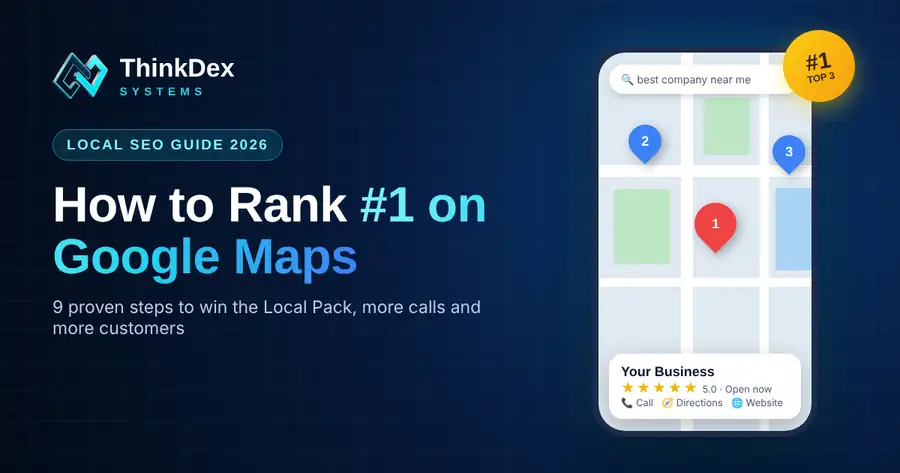
When someone searches “software company near me”, “best dentist in Dubai” or “plumber open now”, Google shows a map with three businesses at the very top, known as the Local Pack. Those three spots get most of the calls, clicks and direction requests. Everyone else is one scroll away from invisible.
The good news: the Local Pack is not reserved for big brands. A small business with a well-optimized profile, real reviews and a clear website can outrank companies ten times its size. This guide shows you exactly how, step by step, the same way we do it for our clients in the USA, UK, Canada, the Gulf and Pakistan.
Key takeaways
- Google ranks local results on three things: relevance, distance and prominence.
- Your Google Business Profile is the single most important local SEO asset you own.
- Reviews, consistent business details and a fast, local-focused website build long-term prominence.
- Local SEO now also feeds AI answers in Google AI Overviews, ChatGPT and Gemini.
What is local SEO?
Local SEO is the process of making your business show up when people nearby search for what you offer. It covers your Google Business Profile, your website, your reviews and how your business appears across the web. Regular SEO helps you rank anywhere; local SEO helps you win customers in a specific city, area or service region.
It matters for any business that serves customers in person or in a defined area: clinics, restaurants, salons, law firms, real estate agents, home services, retail stores, schools and local B2B companies such as IT and software firms.
How Google decides who ranks on the map
Google has publicly explained that local results are based mainly on three factors:
Relevance
How well your profile and website match what the person searched for.
Distance
How far your business is from the searcher or the location in the search.
Prominence
How well known and trusted your business is, online and offline.
You cannot move your office closer to every customer, but you can control relevance and prominence. That is where the work below comes in.
Step 1: Claim and fully complete your Google Business Profile
If you do only one thing from this guide, do this. Claim your profile at business.google.com, verify it, then fill in every field:
- Business name: your real name only. Adding keywords such as “Best SEO Company Islamabad” breaks Google’s guidelines and can get your profile suspended.
- Primary category: the most important relevance signal. Choose the most specific option, then add relevant secondary categories.
- Address or service area: exact and identical to your website.
- Phone, website and hours: including holiday hours. Wrong hours lead to bad reviews.
- Services and products: list each one with a short, clear description.
- Business description: explain what you do, who you serve and where, in natural language.
Step 2: Add photos and post updates regularly
Profiles with real photos look more trustworthy and get more engagement. Upload your logo, cover photo, office or storefront, team and work samples. Replace stock images with genuine ones wherever possible.
Use Google Business Profile posts to share offers, news, new services and blog articles. A fresh, active profile tells both Google and customers that your business is open and engaged.
Step 3: Build a steady stream of genuine reviews
Reviews are one of the strongest prominence signals, and they are often the deciding factor for a customer choosing between three businesses on the map.
- Ask every happy customer. Send your direct review link by WhatsApp or email right after a successful job.
- Reply to every review, positive or negative, politely and professionally.
- Aim for consistency, a few new reviews every month beats fifty in one week and then silence.
- Never buy reviews or offer rewards for them. It violates Google’s policies and can lead to removed reviews or a suspended profile.
Step 4: Keep your business details consistent everywhere (NAP)
NAP stands for Name, Address, Phone. Google cross-checks your details on your website, social profiles and business directories. If one listing says “Suite 5” and another says “1st Floor”, it creates doubt.
Use the exact same format everywhere, then list your business on trusted directories for your country and industry, such as Bing Places, Apple Business Connect, Yelp, industry associations and local chambers of commerce.
Step 5: Make your website a local ranking machine
Your Google Business Profile links to your website, and Google uses your site to confirm what you do and where. Make sure it includes:
| Website element | What to do |
|---|---|
| Location in titles | Include your city or area in page titles and headings where it fits naturally. |
| Service pages | Create one clear page per service instead of one page listing everything. |
| Location pages | If you serve several cities, give each a genuinely useful page, not copied text with the city name swapped. |
| Contact details | Show your full NAP in the footer and on the contact page, plus an embedded Google Map. |
| LocalBusiness schema | Add structured data so search engines read your name, address, hours and reviews accurately. |
| Speed and mobile | Most local searches happen on phones. A slow site loses both rankings and customers. |
Step 6: Earn local links and mentions
Links from relevant, local websites show Google that your business is a real, respected part of the community. Good sources include local news sites, business associations, event sponsorships, partner businesses, universities and industry blogs. One genuine link from a respected local site is worth more than dozens of low-quality directory links.
Step 7: Publish helpful local content
Blog articles that answer real customer questions build relevance and trust. Think about guides, price explanations, checklists and case studies tied to your area, for example “How much does a business website cost in Islamabad?” or “Best ways for Dubai restaurants to get more delivery orders”. Share each article on your Google Business Profile and social media.
Step 8: Prepare for AI search
More people now ask AI assistants for recommendations: “Which IT company in Islamabad has good reviews?” Tools like Google AI Overviews, ChatGPT and Gemini pull from the same signals local SEO builds: clear websites, consistent business information, reviews and mentions across the web. Optimizing for this is called GEO (Generative Engine Optimization). You can learn more in our guide What Is GEO?
Step 9: Track your results
Local SEO is measurable. Check these regularly:
- Google Business Profile Performance: calls, website clicks, direction requests and the searches that found you.
- Google Search Console: which local keywords bring visitors to your website.
- Google Analytics: how local visitors behave and convert.
- Leads and sales: ask new customers how they found you. That is the number that really matters.
Common local SEO mistakes to avoid
- Stuffing keywords into your business name.
- Choosing a broad or wrong primary category.
- Different addresses or phone numbers across the web.
- Ignoring or arguing with negative reviews.
- Creating fake locations or virtual offices to appear in more cities.
- Setting up the profile once and never updating it again.
How long does local SEO take?
Quick wins, such as fixing your profile, categories and NAP, can improve visibility within weeks. Building strong prominence through reviews, links and content usually takes three to six months of consistent work, depending on your competition and city. The businesses that win are rarely the ones that start fastest, but the ones that keep going.
Want to rank #1 on Google Maps?
ThinkDex Systems helps businesses worldwide grow with AI-driven SEO & GEO, Google Business Profile optimization, local content and fast, SEO-ready websites. Get a free local SEO audit and a clear plan for your business.
Frequently Asked Questions
SEO helps your website rank for searches anywhere. Local SEO focuses on searches with local intent, such as "near me" or a city name, and includes your Google Business Profile, reviews and local listings so you appear on Google Maps and in the Local Pack.
Yes. Creating and managing a Google Business Profile is completely free. You only need to verify that you own or represent the business.
There is no fixed number. It depends on your competitors. Focus on getting genuine reviews steadily every month and replying to all of them, rather than chasing a specific total.
Yes. Service-area businesses, such as home services or mobile businesses, can hide their address and set the areas they serve. Creating fake addresses or virtual offices is against Google's guidelines.
Profile fixes can show results within a few weeks. Strong, stable rankings usually take three to six months of consistent work, depending on your city and competition.